How a founder writes the monthly investor update from live numbers
The investor update is due, the numbers live in four places, and it's Sunday night again. Here's how a six-person studio keeps one row of numbers a month and turns it into a short update that goes out on time.
It's Sunday night. The investor update is due tomorrow. Revenue is in the accounting app, cash is in the bank app, the client count is in your head, and last month's update is somewhere in your sent folder. One founder on X described exactly this night: the update due tomorrow and an email from Tuesday still waiting for a reply.
So the update goes out late. Or it doesn't go out this month. Next month there's more to explain, so it gets harder to start.
That's not a discipline problem. The work of an update is mostly gathering, and the gathering is spread across tools that were never meant to sit together. Here's how one small studio fixed the gathering part, and kept the writing short.
Why updates matter more than founders think
Investors read them closely. One small angel noticed that only about half the founders they back send regular updates, and was surprised. A commenter on Hacker News remembered Paul Graham, who started Y Combinator, saying it was the founders he stopped hearing from that he started to worry about.
And the update helps you as much as them. Graham once wrote that writing things down sharpens your thinking, so the update is ultimately for you. One founder on Hacker News compared it to closing the books: the best ones don't take long to write, because they've been in the making all month.
What a good monthly update holds
People who read a lot of these agree on the shape.

- One line on what you do. An investor on Hacker News said the good ones start with a "we make X for Y" line, then runway and burn, then the numbers that matter to the business.
- Numbers before words. Graham put it bluntly: when startups are doing well, updates are short and full of numbers. When they're not, they're long and mostly words.
- Short. Guillermo Rauch praised an update that was one sentence and six bullet points, with a call to action, over a four-page PDF.
- A specific ask. Cristina Cordova described the opposite of useful: a founder lists clear asks and the investor replies "let me know if there's anything I can help with". Make the ask so specific that it's easy to act on.
- Thank yous. One investor suggested a thank-you section at the bottom for people who helped. It costs one line.
None of this is hard. It just needs the numbers to be in one place when you sit down.
How Northwind Studio does it in Team Brain
Northwind Studio is a made-up six-person design studio with a small angel round. Here's the setup, start to finish.

1. One table, one row a month. The founder keeps a table called Monthly numbers. Each month is a row: revenue, active clients, monthly burn and cash in the bank. A formula column divides cash by burn, so runway is always worked out and never typed.
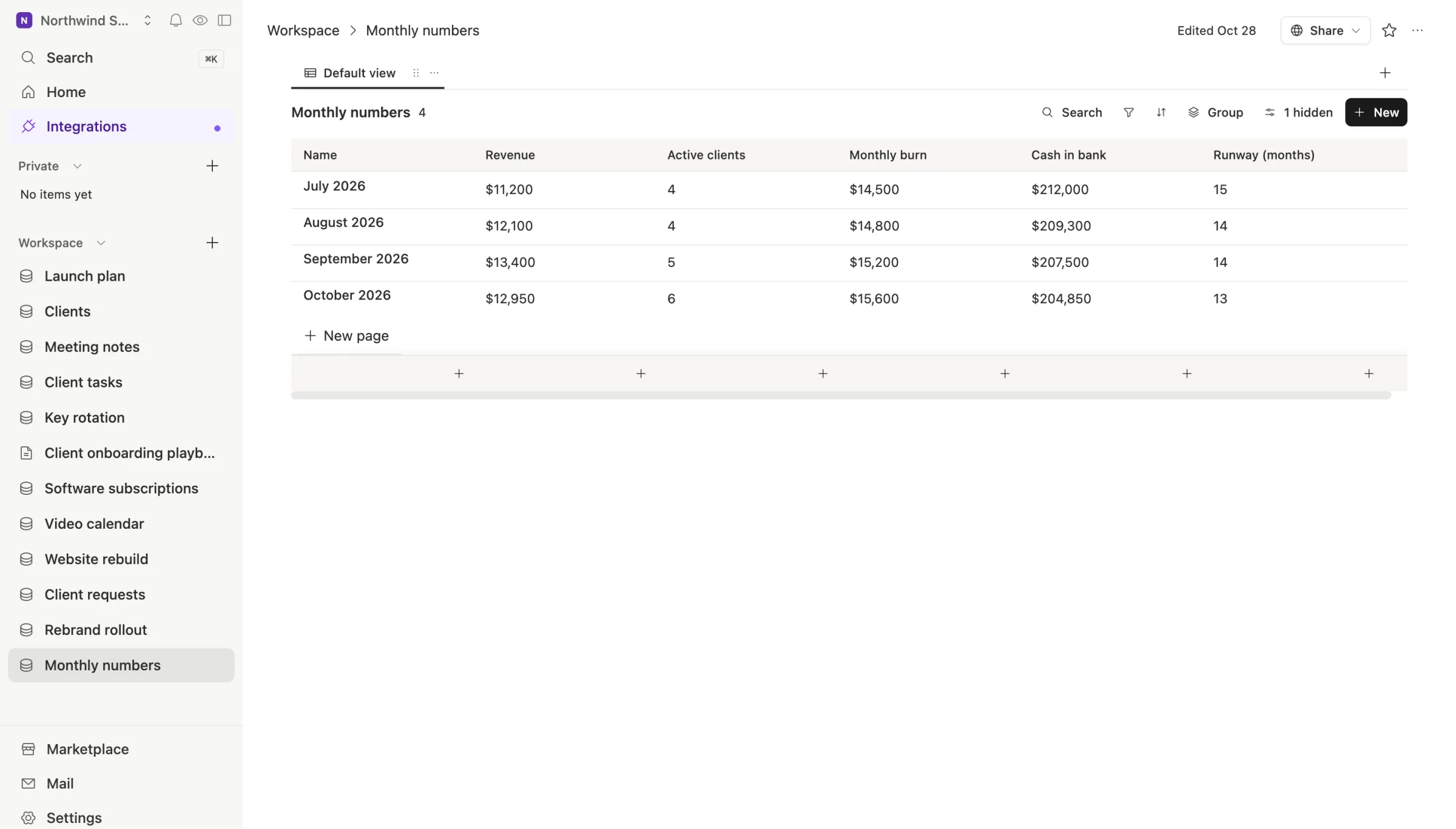
Filling a row takes a few minutes on the first of the month, while the numbers are fresh. If revenue already sits in another table, like a Clients table with monthly values, the row can pull from it instead of being typed twice.
2. Write the ask first. Each row has a column called The ask. It's filled in before anything else, because it's the line most likely to be skipped. This month it's "intros to two real estate brokers."
3. Let the AI draft it. The founder opens the month's row and asks Team Brain's chat to draft the update in the same shape as last month's: one line on what the studio does, the numbers with the change from last month, the ask, the good, the not so good, and the thank yous. It reads the row and the previous update and writes the draft into the row's page. It asks before it writes anything.
4. Edit and send. The founder reads it as an investor would, fixes anything that sounds off, adds the one thing the numbers can't say, and pastes it into an email.
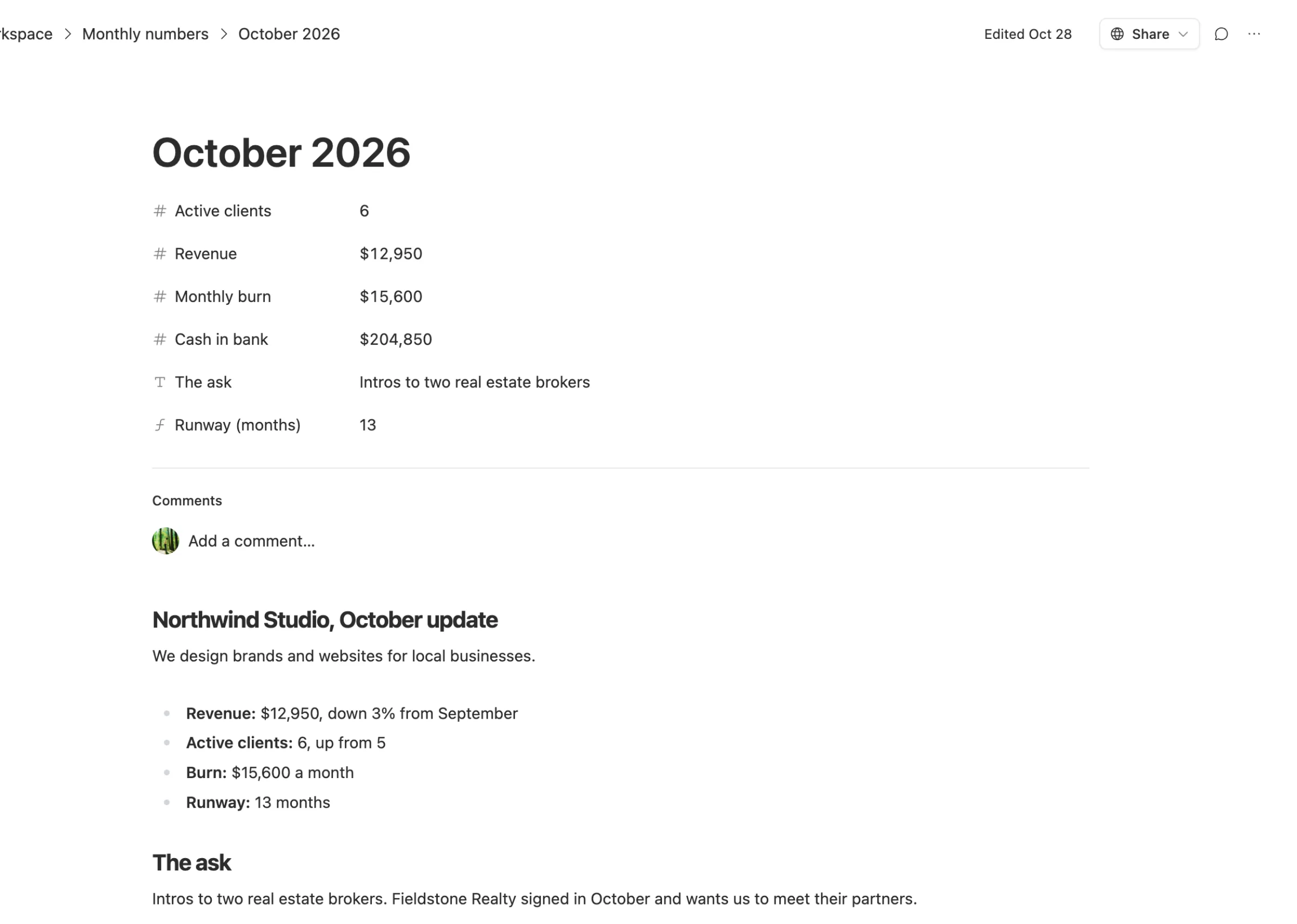
The bad month stays in. October's revenue dipped because a client's launch slipped, and the update says so in one line. Investors expect lows. A commenter on Hacker News quoted one who gets worried when a company reports none at all.
Why the usual tools make this hard
Doc tools are great for writing the update and poor at holding the numbers. Spreadsheets are the opposite. So most founders end up with both, plus their bank and accounting apps, and they copy between them once a month. Jason Lemkin's advice is to send updates quickly, in a format that takes 15 to 20 minutes. That only works when the numbers are already waiting for you.
Keeping the numbers and the writing in one place is the whole trick. Every update also becomes a record you can scroll back through, month by month, when it's time to raise again.
What it costs
The Team Brain workspace is free for any number of people, as our pricing page shows. The only cost is the AI you use for the draft, and you can bring your own AI account instead. One draft a month is a small job.
Common questions
Do I have to use AI for this? No. The table and the row alone fix most of the problem. The AI draft just saves you the blank page.
Can my cofounder see it? Yes. Share the table with them, or keep it private to you. Investors don't need access; they get the email.
What if I'm not raising money? Write it anyway, for yourself or your team. A monthly look at revenue, burn and runway is worth having either way.