How a small dev team tracks bugs without Jira
Bug reports land in chat, email and a sticky note, and the one that matters gets lost. Here's how a small studio keeps every bug on one board, linked to the client, with steps anyone can follow to see it again.
A client emails "the form is broken." Someone forwards it to the team chat. A developer replies "on it," opens the form, and it works fine. Three days later the client writes again, a bit sharper this time.
Nobody dropped it on purpose. The report said what was wrong, not how to see it. And it lived in a chat thread, which scrolled away by lunch.
This is how Northwind, a six-person studio that builds sites for small businesses, keeps track of bugs across six clients without a heavy tracker.
Most bugs aren't hard. They're lost.
There's a long thread on Hacker News this week about why writing correct software is hard. One developer broke their own bugs down roughly like this: about half are the wrong thing built the right way, about half come from something the software talks to, like a library or an API, and only a sliver are plain code mistakes.
Both big halves start with a missing detail. What did the client actually expect? Which phone, which browser, which network? A bug report without those isn't a bug yet. It's a rumor.
Another commenter described tickets where a tool that had worked for twenty years was suddenly "broken", because someone's idea of correct had changed. You only catch that if the report says what the person expected to happen.
Why the usual tools don't fit a team this size
Small teams usually land in one of two places.
Chat and a known-issues file. It's free and it's where people already are. But a thread doesn't have a status, and a list in a file just grows. One builder on X called their known-issues file a graveyard, and wrote an agent just to visit it every night.
A full issue tracker. Jira and Linear are built for product teams shipping one app. They're good at it. But a studio's bugs belong to clients, sit next to client notes and invoices, and get reported by people who'll never log into a dev tool. Pricing is per person too. Linear's free plan covers 250 issues and 2 teams, then it's $10 or $16 per user a month on yearly billing.
A founder who chose per-plan pricing for their own tracker explained the math honestly: per seat is cheaper for 2 or 3 people, and somewhere between 4 and 8 people it flips.
Four columns, one rule
Northwind's whole process fits in four columns. The rule is about the second one.

New means someone saw something. It needs who saw it, where, and what they expected.
Can reproduce means there are steps anyone on the team can follow to see it happen again. A bug doesn't move past this column until those steps exist. That's the rule.
Fixing means one named person owns it, and it's linked to the client.
Fixed means someone ran the same steps again and it didn't happen.
One developer on X who spent seven hours chasing a single bug with AI came away with the same lesson: find the root cause first, and shrink the bug to the fewest steps. The Can reproduce column just makes that step impossible to skip.
The board in Team Brain
Northwind keeps its bugs on a board in Team Brain, in the same workspace as its clients and meeting notes.
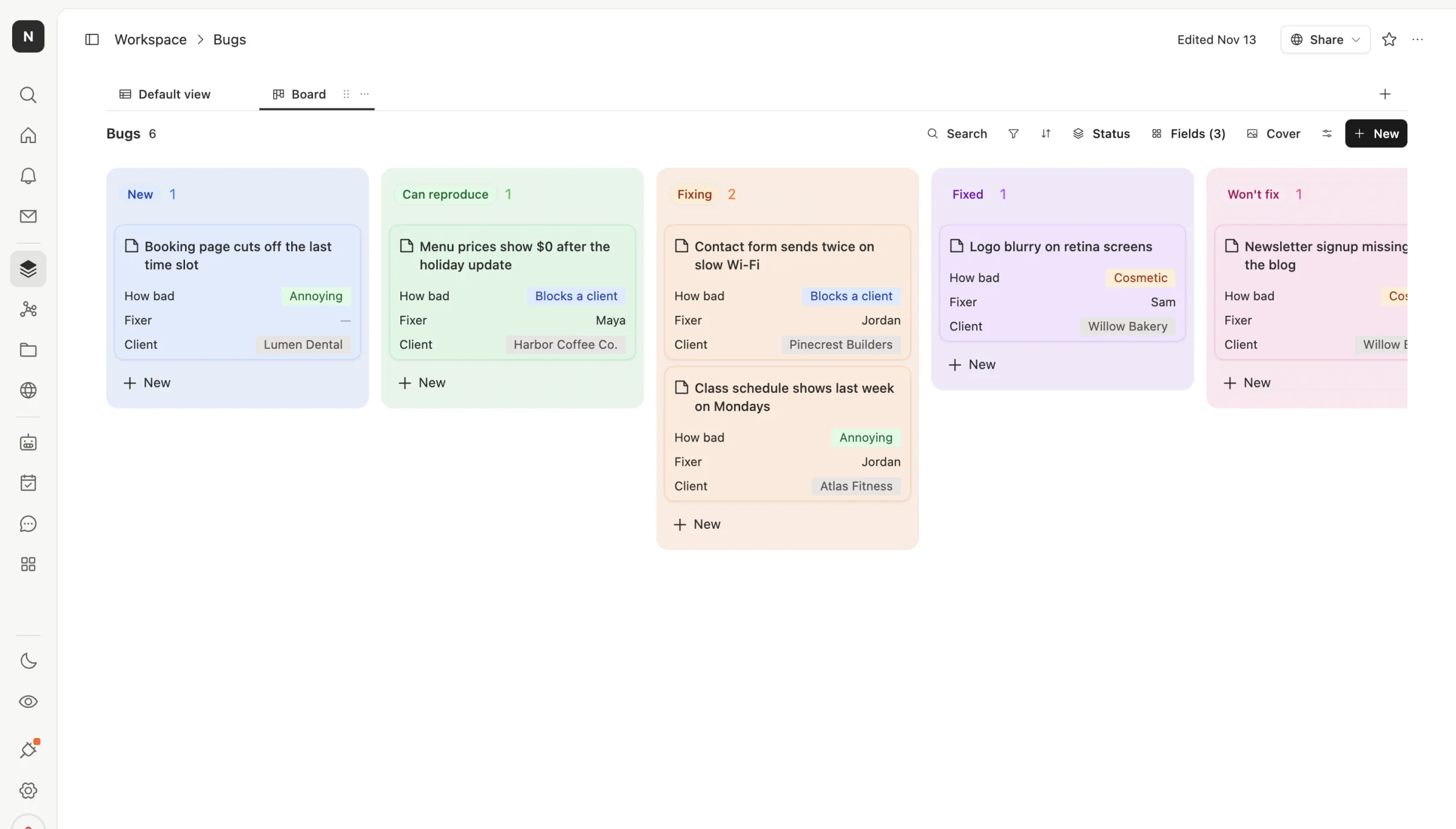
Each card shows three things: how bad it is (blocks a client, annoying, or cosmetic), who's fixing it, and which client it belongs to. The client is a real link to the row in their Clients table. Open Pinecrest Builders and you see their open bugs next to their renewal date and last meeting.
A Won't fix column matters more than it looks. Saying no out loud, with a reason, beats a card that sits in New forever.
Every bug opens into a page anyone can follow
Click a card and it opens into a full page. The fields sit on top. Underneath is a short write-up with the same four parts every time.
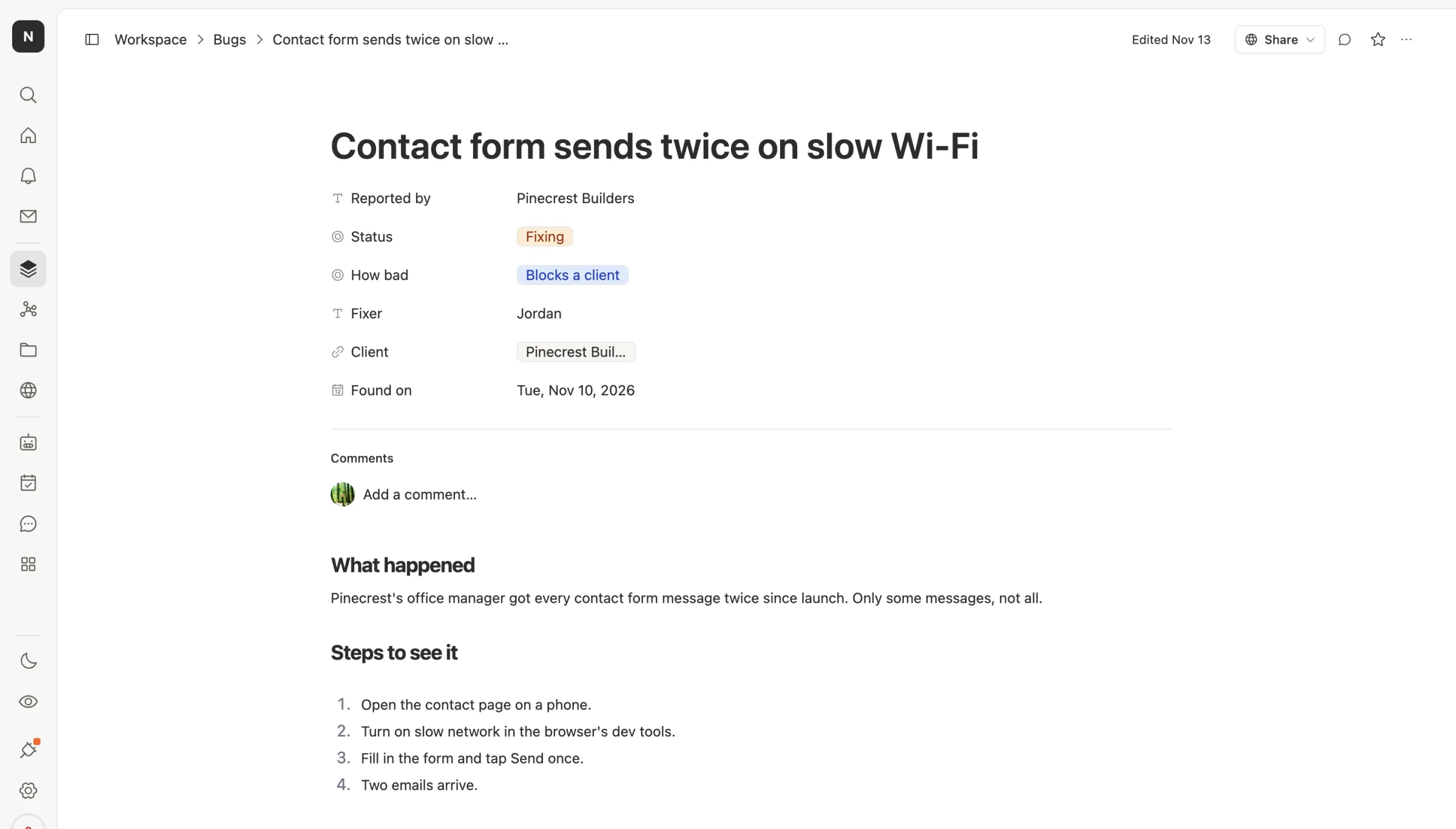
What happened, in the reporter's words. Steps to see it, numbered, starting from a blank browser. Expected, one line. Fix, filled in by the fixer, including how they'll check it.
Here, Pinecrest's office manager got every contact form message twice. The steps say: open the contact page on a phone, slow the network down, tap Send once, and watch two emails arrive. Anyone can see it now, so anyone can check the fix.
Because the workspace has no seats, the client's own account manager can file the bug straight onto the board. The person who heard about it writes it down, instead of passing it on.
Let an agent do the triage chores
The boring parts are good jobs for an agent. In Team Brain you could set one to run each morning and:
- Read every card still in New and draft the missing questions: which device, which page, what did you expect?
- Flag anything marked "Blocks a client" that hasn't moved in two days.
- Post a short list to the team of what was fixed yesterday, grouped by client, ready for the Friday client email.
It writes notes and drafts. A person still decides what gets fixed first.
What it costs

The board, the pages and the client links are part of the free workspace, and there are no seats, so clients' account managers and part-timers can file bugs too. An agent doing triage uses AI each run, paid per use or on your own AI account.
When a real issue tracker is the better call
If your team ships one product with sprints, releases and a tight link to your code, a dedicated tracker earns its seats. Linear connects to your pull requests and cycles in ways a general workspace doesn't.
One person put it plainly on X: yes, you can build your own Linear for a 7-person company, but is that the best use of your time? For a product team, probably not. For a studio whose bugs belong to clients, a board next to the client list is usually enough.
Common questions
Do we need to stop using chat for bugs? No. Chat is where bugs show up. Just move each one onto the board the same day, with steps.
What if we can't reproduce it? Leave it in New and ask the reporter one specific question. If it still can't be seen after a week, move it to Won't fix with a note.
Can clients see the board? You can share a view filtered to one client, so they see only their own bugs and where each one stands.
How do we decide what to fix first? Blocks a client goes first, then anything that's been waiting longest. Keep it that simple.