How a small team runs social media with AI agents
Six bots can fill a content calendar. Here's how a small team splits social media between agents and people, keeps its own voice, and runs the whole week from one table.
It's Sunday night and the content calendar for the week is empty again. You know you should post three times. You have a client project due Tuesday. So you open a blank doc, stare at it, and write "ideas?" at the top.
Most small teams live here. One founder building a social agency put it simply: a strong Instagram presence takes consistency most small teams don't have time for. It's not a talent problem. Posting is a job that never ends, sitting on top of the job that pays.
This week a post on X went around with a tempting fix: six bots can turn one person into a whole social team. One hunts trends, one writes, one designs, one publishes, one tracks results, one runs the rest. Some of that works well. Some of it is how you end up posting things that sound like everyone else.
Here's how we'd split it, shown with Northwind Studio, a made-up five-person design agency we keep for demos.
What to hand to agents, and what to keep

Agents are good at the blank page. Finding five things worth posting about this week. Turning a client project into a first draft. Noticing that Thursday has nothing scheduled.
People are good at taste. Readers notice. One account summed up the tell: the overly polished tone, the perfect structure, the same predictable wording. An agent can draft. A person decides what sounds like you.
Anything about a client needs a person. Whether Harbor Coffee is happy to be tagged is not a question for a bot.
Publishing stays with a person. It's one click. It's also the click you can't take back.
One table for every post
Northwind keeps every post in one table called Social posts. Each row is one post: its status, the channel, the day it goes out, who owns it, and whether an agent or a person started it.
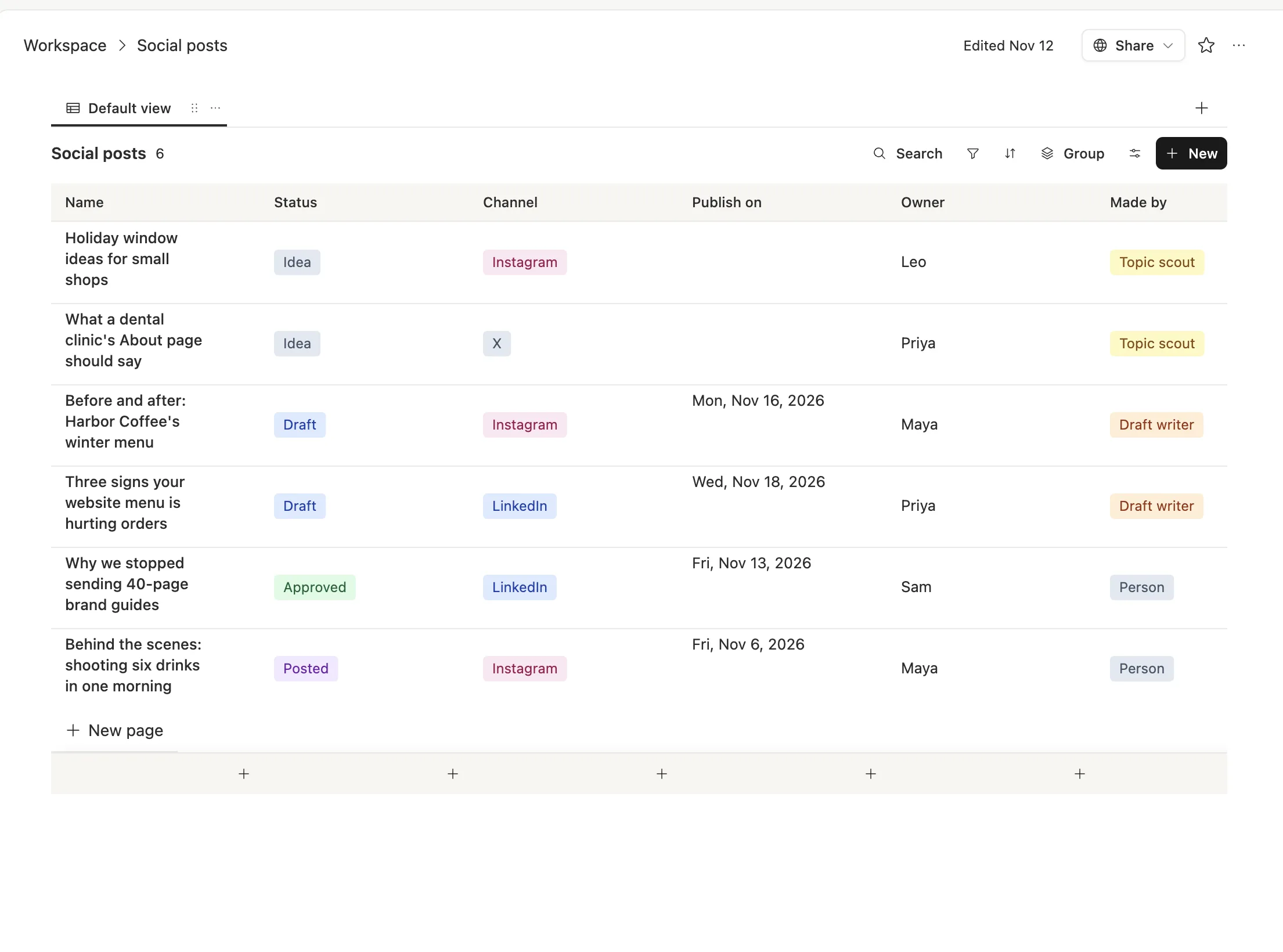
Four statuses are enough: Idea, Draft, Approved, Posted. The "Made by" column matters more than it looks. When a draft feels off, you know whether to fix the agent or talk to a teammate.
Each post keeps its reasons
Open a row and the draft sits with the reason for the post and notes for whoever reviews it.
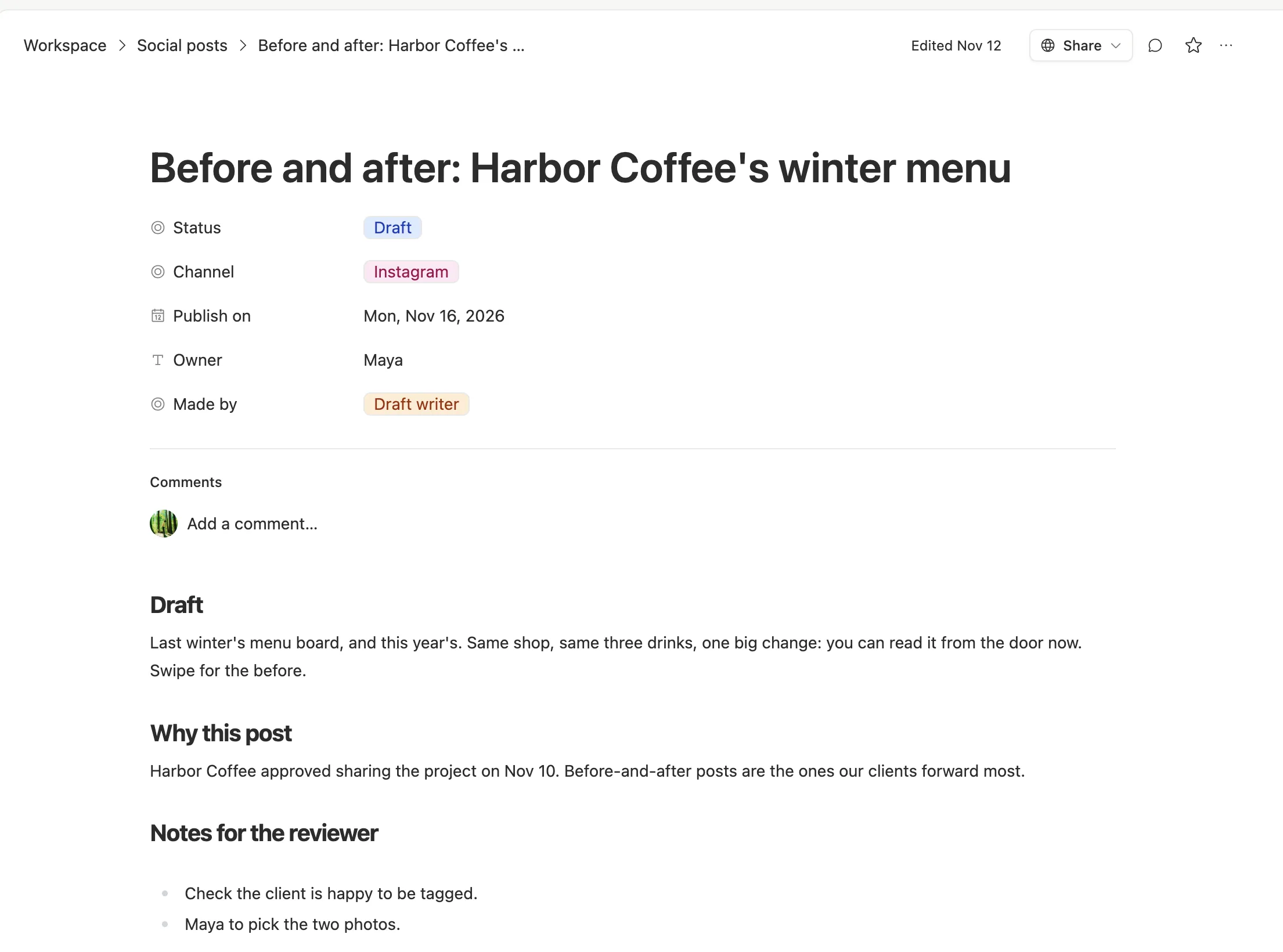
That "Why this post" line is the habit that keeps the feed honest. If an agent can't say why a post is worth a reader's time, it doesn't get drafted.
How the week runs

Monday: the topic scout. An agent runs every Monday morning. It reads the week's client work in the workspace, searches the web for what's being talked about in your clients' trades, and adds five ideas as rows marked Idea. A person stars the two or three worth doing.
Tuesday: the draft writer. A second agent runs when a row's status changes, and writes a draft for each picked idea. It follows the voice notes you gave it: ten posts you liked, words you never use, how long a post should be.
Wednesday: review. A person reads every draft. Edit it, approve it, or kill it. Killing is fine. A dead draft cost an agent a minute, not you an afternoon.
Post and mark it. A person posts the approved ones on Instagram and the other channels, then sets the row to Posted.
Each agent has a cost cap per run and a time limit, so a loop can't run up a bill overnight. Both can run on a smaller model, since sorting ideas and writing a short draft aren't the hardest jobs.
What it costs
Scheduled agents like these are cheap to run. One builder pulled their weekly usage report and found their scheduled bots cost almost nothing; chatting with the bots was where the usage went. Your numbers will depend on your model and how often agents run.
The Team Brain workspace itself is free for any number of people. You pay only for the AI your agents use, or connect your own AI account and pay your provider directly. See our pricing.
We won't promise you a number of followers. What changes is simpler: Sunday night starts with five ideas already on the table.
Getting started
- Make the table. Name, Status, Channel, Publish on, Owner, Made by.
- Write your voice notes. Ten posts you're proud of and five rules. This is the most useful hour you'll spend.
- Add the topic scout first. Run it by hand for two weeks before you put it on a schedule.
- Add the draft writer when you trust the ideas. Keep the review step forever.
Common questions
Will AI posts sound generic? They will if nobody edits them. Give the draft agent real examples of your voice, and keep a person on every post before it goes out.
Can the agents post for me? We'd keep publishing with a person. A draft can be wrong in ways only you'd notice.
How many agents do I need? Two is plenty for a small team: one to find ideas, one to draft. Add more only when a step is clearly the bottleneck.
Does this work for a solo founder? Yes. The table and the two agents work the same for one person. The review step just takes less negotiating.