How a small VC fund tracks deal flow without a $2,000 seat
Three partners, a few hundred founders a year, and notes scattered across inboxes. Here's how a small fund keeps every deal on one table, writes the same tests on every page, and walks into the partner vote on the same page.
It's Monday partner meeting. Someone asks, "Didn't we see a restaurant bookkeeping company last spring?" Two partners half remember. One thinks it was a referral from a founder. Nobody can find the notes, so the founder gets asked the same questions again.
That's not a sloppy fund. It's three busy people, a few hundred first calls a year, and notes that live wherever each partner happened to type them.
This is how a small seed fund can keep every deal in one place, ask the same questions every time, and stop paying thousands per partner to do it.
Where deal flow leaks
The founders reach you by every door at once: a forwarded intro, a demo day, a co-investor's text, a cold email. Each partner keeps their own trail.
One person building tools for funds put the leak well: the expensive part isn't the subscription, it's the tabs. Database to CRM to email for every contact, and the data is still stale when you land. Deal flow breaks in the gaps.
The usual path goes like this. A fund starts in a spreadsheet or Airtable, outgrows it, and moves to a relationship CRM. One investor asked their network a few years ago which CRM to use because they were past the stage of Airtable and were looking at Affinity. That's a normal step. It's also a big jump in price.
Two tests, written on every deal
The fix that matters most isn't a tool. It's asking the same questions on every deal, so partners compare like with like.
One seed fund shares the mental models from its own pipeline discussions on X. Two of them fit any fund.
The 15-minute replication test. If one prompt or a few hours of vibe-coding reproduces 80 percent of the product, the tech isn't the thesis. So you judge the team, the distribution and the data, or you pass.
The overnight test. Ask the founder for something that's missing, like a model, references or a customer intro, and watch how fast it appears. Their example: they asked a founder for a data room he didn't have, and he had one by the next morning.

Both tests only work if someone writes down the answer. The overnight test is useless if nobody notes when the ask went out and when it came back.
One table for every deal
Here's that process as a single table in Team Brain. The companies are made up. The columns are the ones a small fund actually needs.
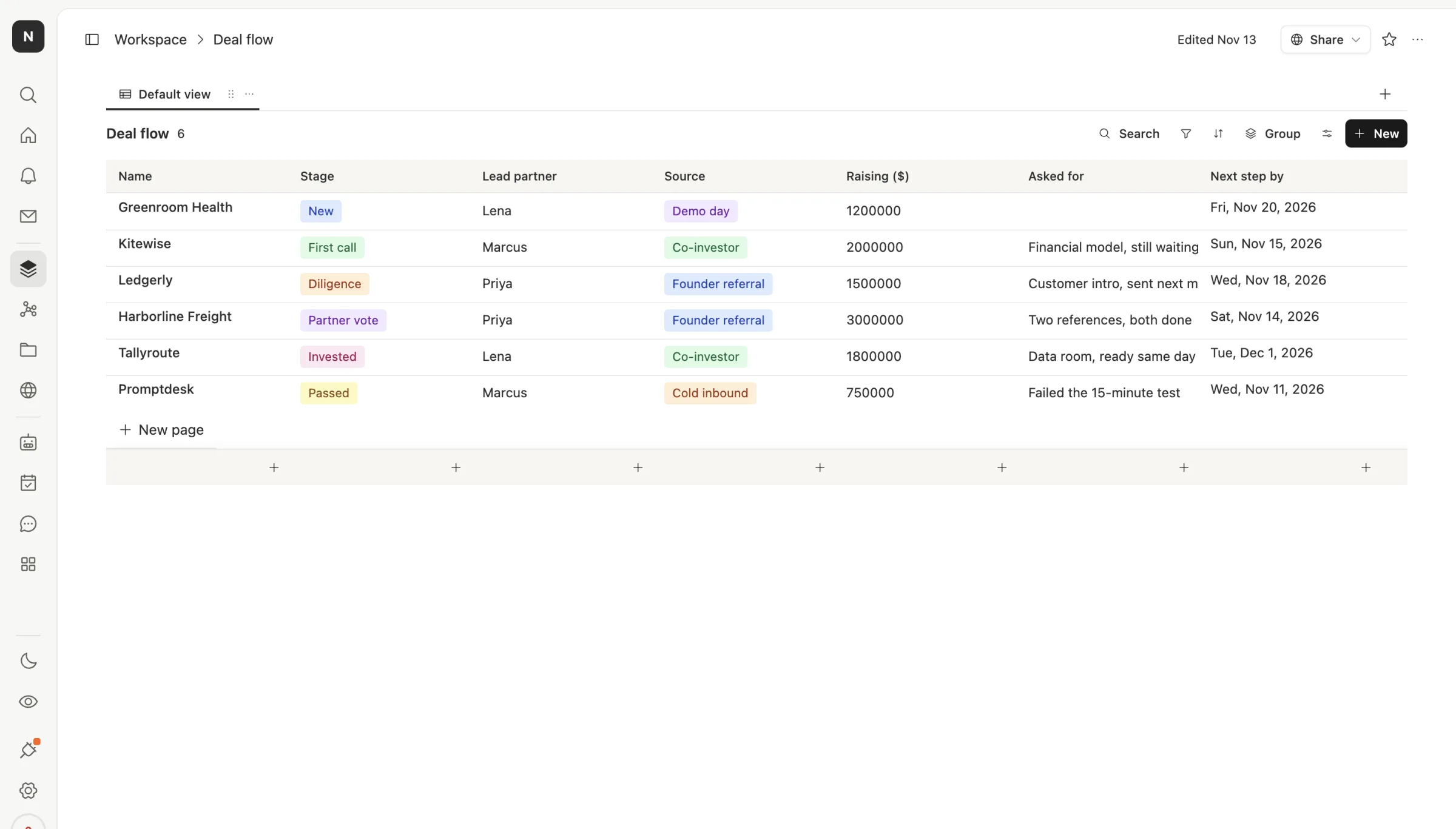
Stage runs New, First call, Diligence, Partner vote, Invested, Passed. Source tells you later which doors bring the best deals. Asked for is the overnight test, in one line: "Customer intro, sent next morning" next to "Financial model, still waiting." You can read the difference from across the room.
Next step by is the date that keeps a deal from going quiet. Sort by it on Monday and the meeting agenda writes itself.
Because Team Brain has no seats, the associate, the venture partner and the scout can all use the same table. Nobody's notes stay in a private inbox because their seat wasn't paid for.
Every deal opens into the same page
Click a company and it opens into a page with the same headings every time: one line, why now, the 15-minute test, the overnight test, open questions, and the decision.
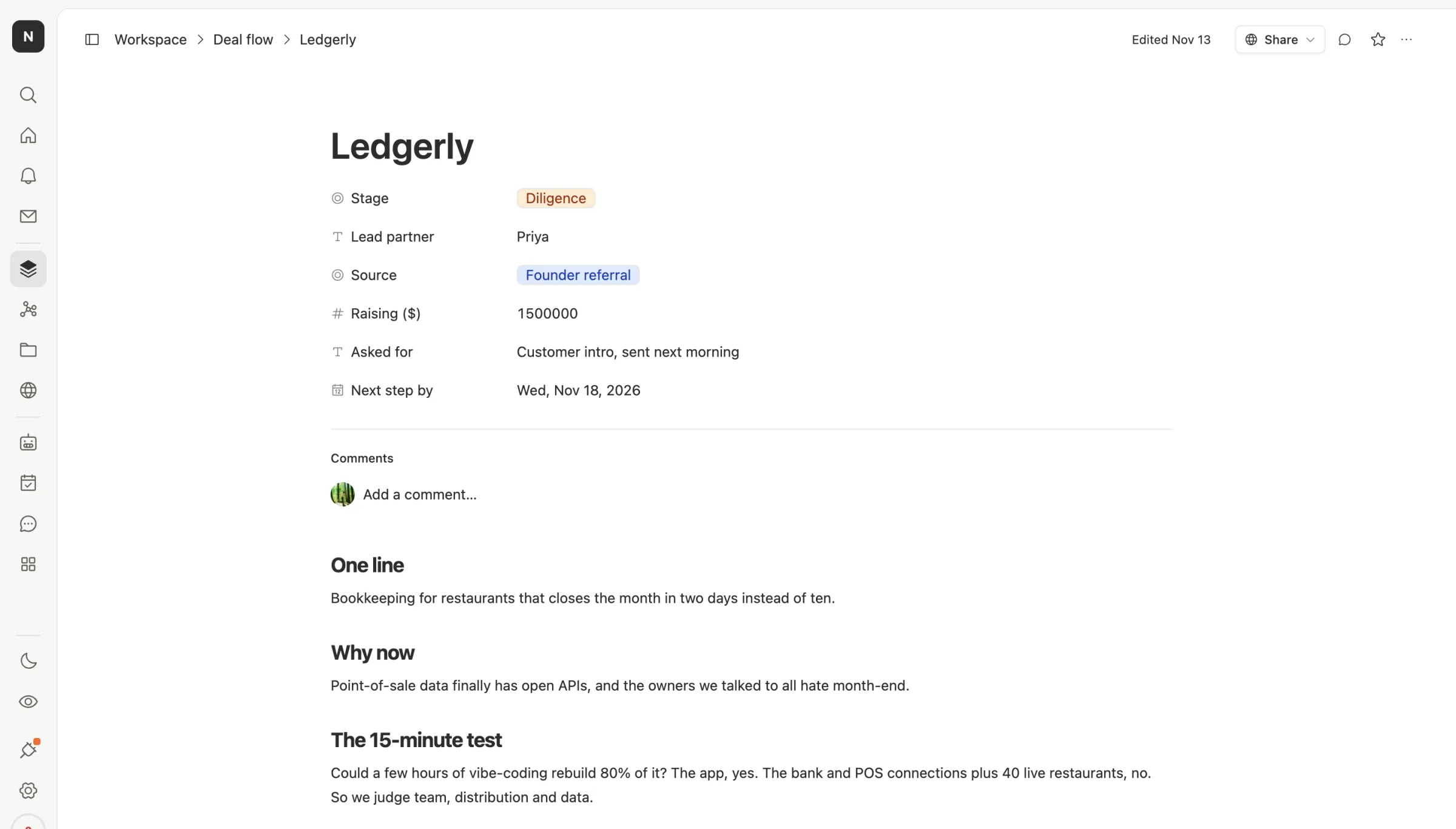
Here, the app could be rebuilt in an afternoon. The bank and point-of-sale connections plus 40 live restaurants couldn't. So the fund judges the team and the distribution, and the overnight test says the founder moves fast.
When the vote comes, every partner has read the same page. And next spring, when someone asks "didn't we see a restaurant bookkeeping company?", one search finds it, with the reason you passed or invested.
Let an agent do the busywork
Some funds build their whole CRM themselves now. One story going around this week: an investor started using Claude Code, cancelled HubSpot the next day and had his own CRM a week later, then cancelled Affinity too. Most small funds don't want to maintain software. They want the chores done.
In Team Brain an agent can do them inside the table:
- After a first call, turn the pasted notes into a deal page with the same headings, and fill in the raise and the source.
- Every Monday morning, list the deals whose Next step date has passed, grouped by partner.
- For the overnight test, flag any ask that's been waiting more than two days.
It writes drafts and lists. Partners still make every call.
What it costs

Affinity lists $2,000, $2,300 and $2,700 per user a year on its three main plans, checked November 13, 2026. For three partners that's $6,000 to $8,100 a year, before an associate or a scout gets a seat.
Team Brain's workspace is free for any number of people, and you pay only for the AI the agents use, or run them on your own AI account.
When a relationship CRM is worth it
Affinity is built for a job a table doesn't do: it reads your team's email and calendar and maps who knows whom. If your fund wins deals through warm intros across a big network, that relationship map is worth paying for.
It's not perfect either. One user said the new Affinity looks nice but still has bugs with shortcuts and file imports. But for a large team living on intros, it does something real.
For a fund of two to five people that sees a few hundred companies a year, the bigger win is simpler: one table, the same tests on every page, and nobody's notes stuck in one inbox.
Common questions
Can we bring our deals over from a spreadsheet or Airtable? Yes. Export a CSV, import it into Team Brain as a table, then add the Stage and Next step columns if you don't have them.
Can LPs or co-investors see a deal? You can share a single page or a view with someone outside the fund, and keep the rest private.
Should the overnight test count against a founder who's slow? It's a signal, not a verdict. Write down what you asked for and when it came back, and let the partners weigh it.
Do we need agents to start? No. Start with the table and the page headings. Add an agent when the Monday list gets long.